Activity inventory
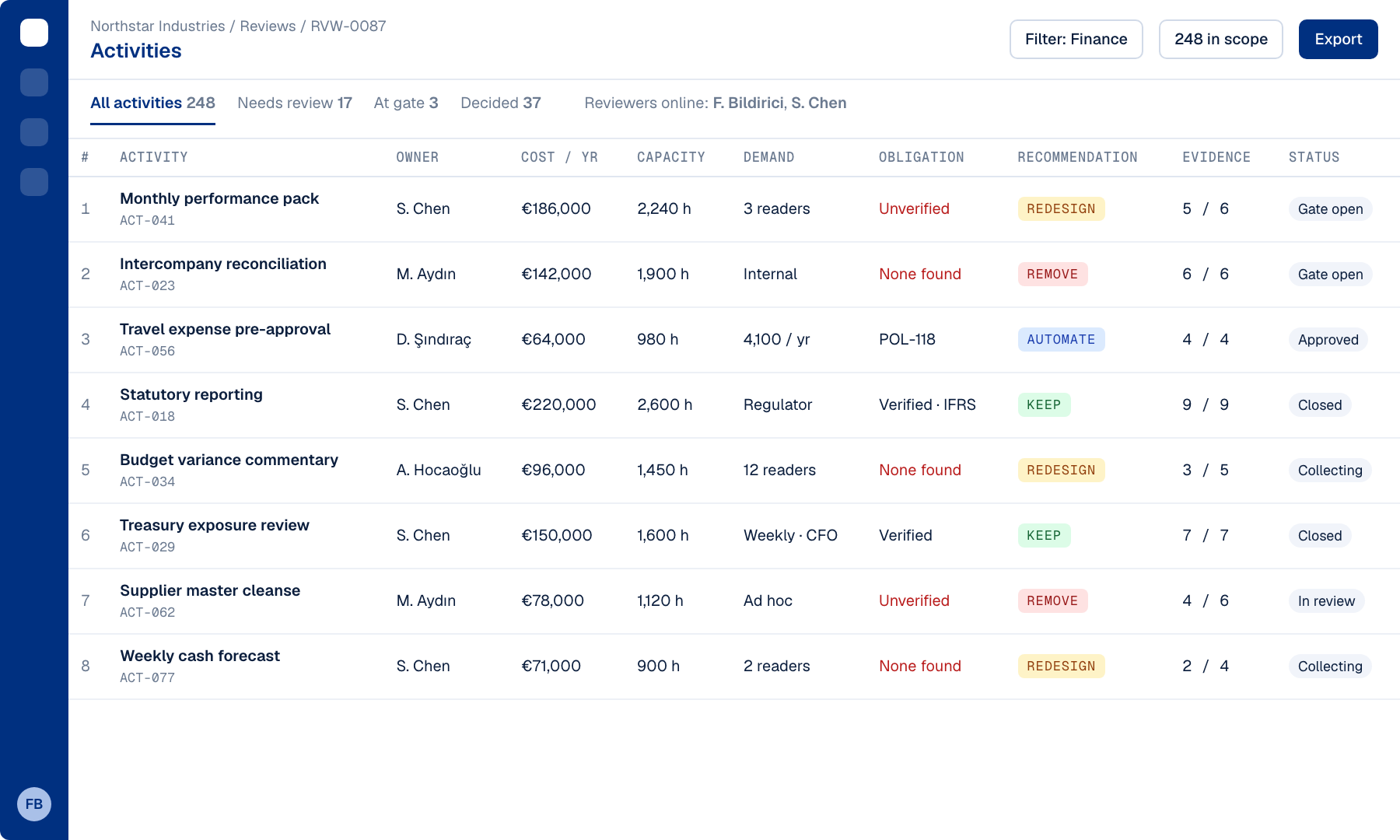
Every recurring activity with cost, capacity, demand source and obligation state, built from event metadata rather than a workshop.
Product
ZeroBase Review finds the documents, meetings and flows a function can stop doing, writes the clean sheet deck and takes it to a decision. ZeroBase Memory keeps that decision alive, with its evidence and a date to look again, and notices when the work grows back.
One function, eight weeks. Every recurring document, meeting and flow listed from the systems it runs on, with what it costs and who still needs it; a twelve slide clean sheet deck written from the figures; a named person deciding what to remove, redesign, automate or keep.
The answer to “would you build it again” changes every time the tools do. The workspace stays live after week eight: each decision comes back on its date with the evidence it rested on and what has changed since, and when a removed meeting returns under a new name or a retired document gets a new copy, a gate reopens.
Four screens, in the order the review walks them. The tour advances on its own; click a step to hold it.
InventoryEvery recurring document, meeting and flow, from the systems it runs on. Cost, capacity, demand and obligation on every row; copies, calendar hours and rule-less steps beside them.
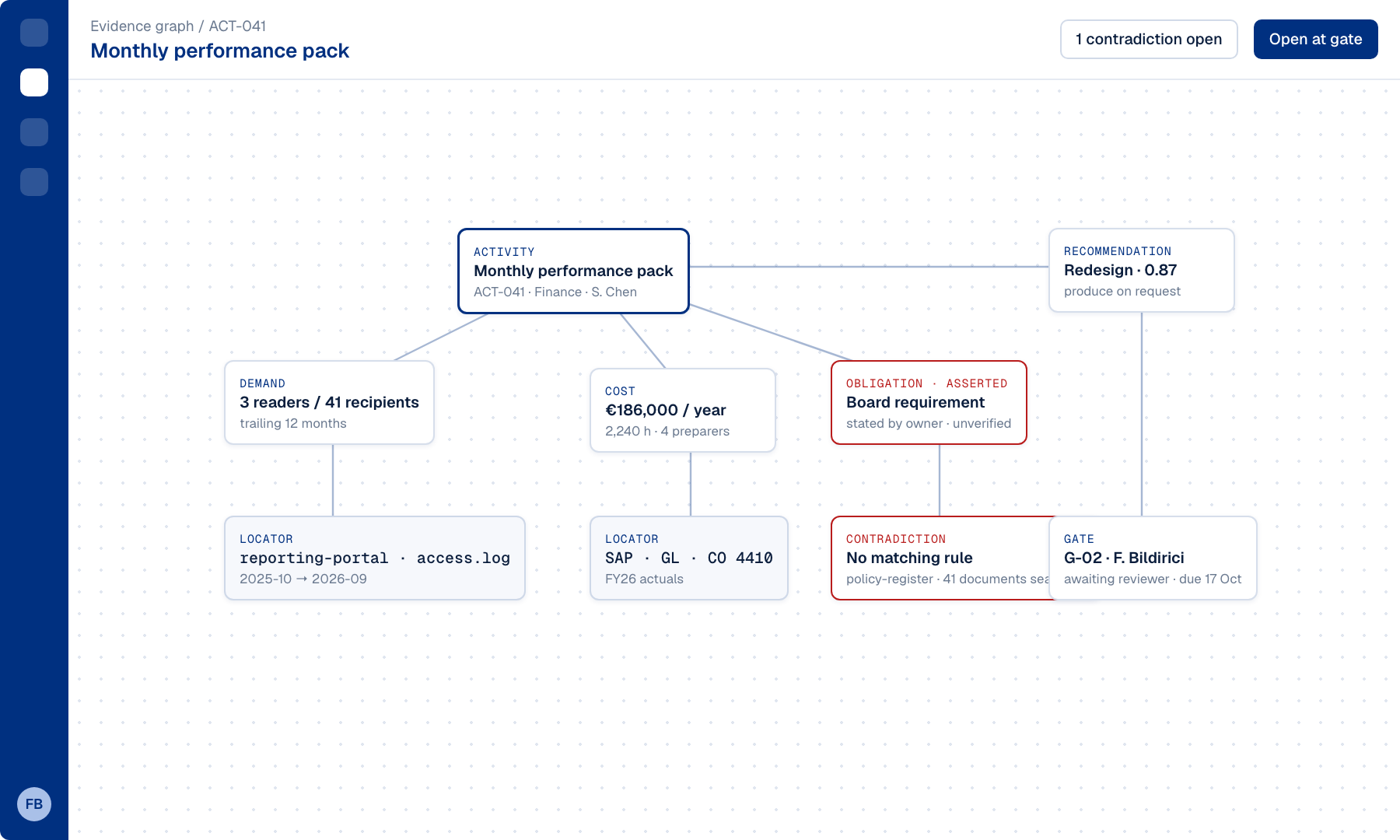
EvidenceEach figure traced to its system, query and period. The contradiction stays visible until a person resolves it.
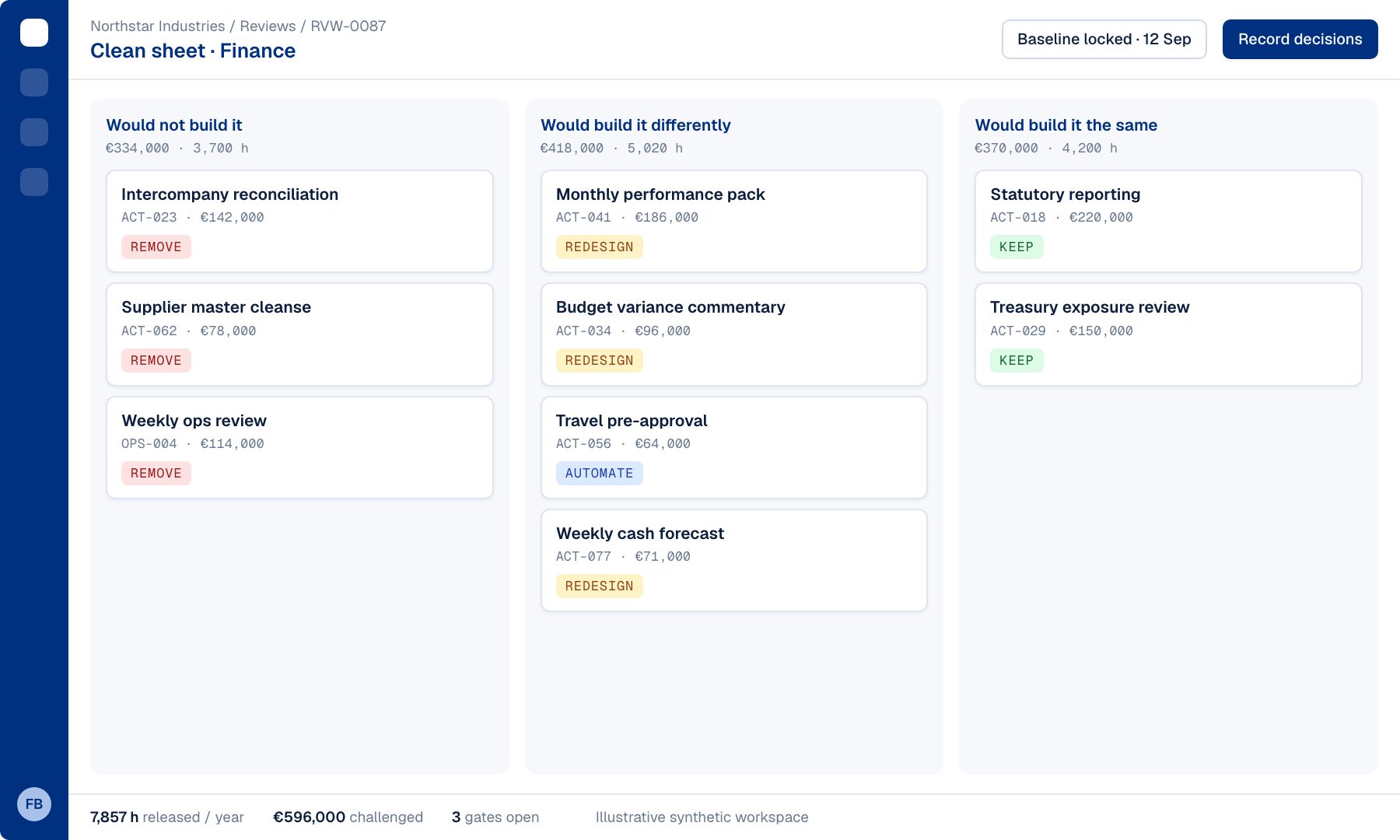
Clean sheetWould you build it again? Each item moves into a column with its AI-native alternative, and the narrator writes the deck the reviewer sees at the gate.
GateA named reviewer, screened for conflict, moves the decision in one of six directions. Nothing consequential passes without a person.
Every recurring activity with cost, capacity, demand source and obligation state, built from event metadata rather than a workshop.
Remove, redesign, automate or keep, with the reasoning attached to each and the capacity delta that moves with it.
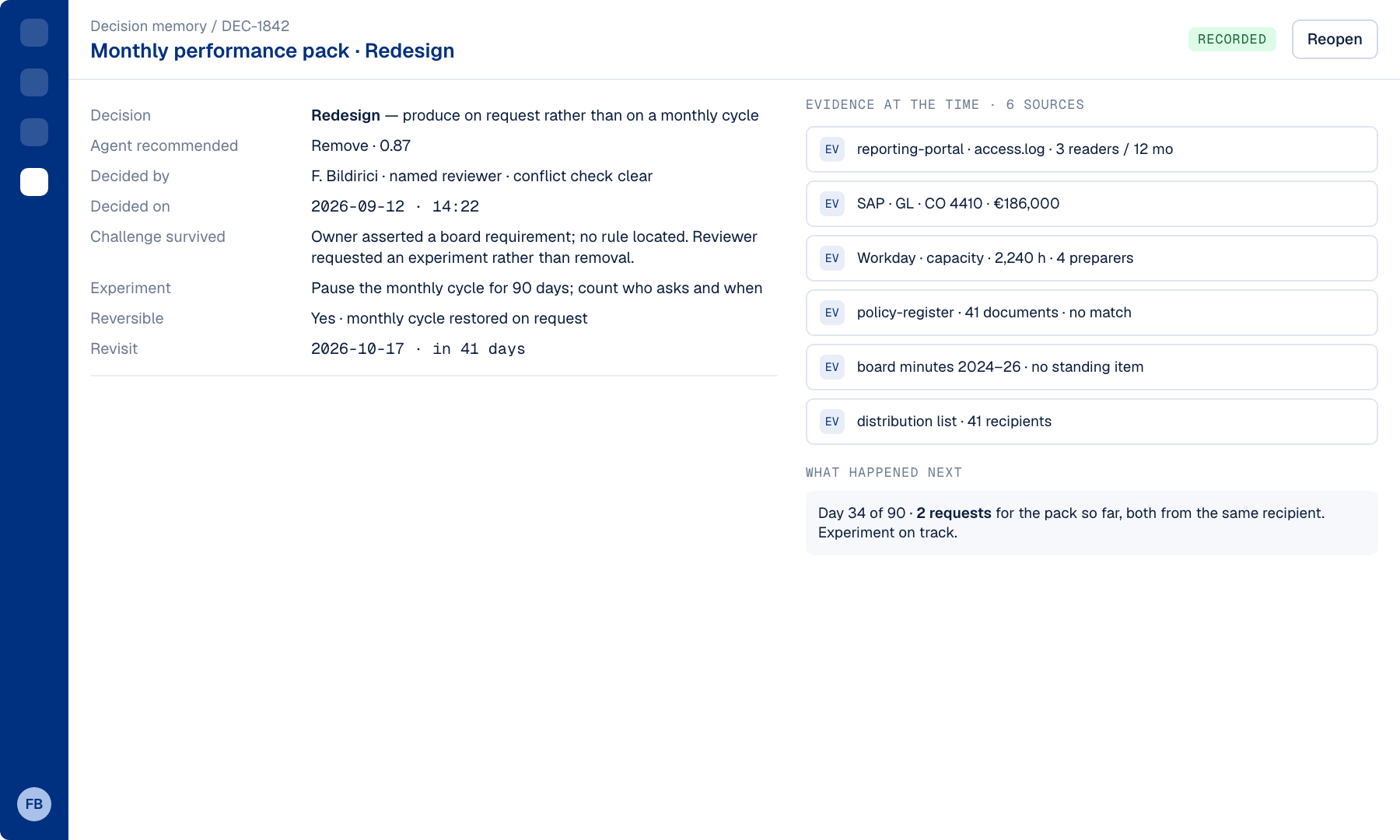
Who decided, on what evidence, under which conditions, with a reversibility class and a date to revisit.
Producing a recommendation is becoming a commodity. Holding why you decided, on what evidence, and when to look again is not. And the answer changes every time the tools do.
Every decision carries a date the organisation will look at it again. The workspace brings it back with the evidence at the time.
When a source, a threshold or a rule changes, the figures behind a decision are re-run and the delta is shown, not silently rewritten.
Decisions, experiments and their outcomes become the starting point of the next review instead of being rediscovered.
| ZeroBase Review | ZeroBase Memory |
|---|---|
| Start here: one function, eight weeks, a decision per document, meeting and flow. | Continues after week eight: the workspace stays live. |
| Reads the systems the function runs on and builds the inventory. | Watches those systems for the changes that matter to a recorded decision. |
| Stops consequential recommendations at a named reviewer. | Brings a decision back to a named reviewer on its revisit date. |
| Ends with a frozen deck, a delta plan and a decision record. | Reopens a gate when the removed work grows back; keeps a live waste ledger, not a monthly pack. |
The question is not a removal list. A company founded today, with AI, would still build four things, and the review keeps them.
A regulation, a contract, a board resolution: located, dated and attached to the activity it requires.
A step that has stopped something in the last eighteen months has earned its place in the chain.
Consequential calls stay with a reviewer, screened for conflict, with the trail attached.
Where the rule runs out, a person looks. The agent brings the case; it does not decide it.
Most of what fails the question is redesigned, not removed outright. The question takes out the scaffolding around these four things, not the things themselves. In the scenario on this page the agent said remove and the reviewer chose an experiment.
The category is easy to mistake, so the boundary is worth stating plainly.
Eight weeks, one bounded function, one decision model with an owner against every line.
 A Future Innovation Agents product