
A consulting deck
Two quarters of interviews that end with a document, built from what people remember doing.
If you founded the company today, with AI, would you build this again? ZeroBase asks that of one function at a time, with the evidence attached and a named person deciding.
Start a Clean Sheet Review →“Embrace ablation: regularly delete old system prompts and scaffolding; modern models are intelligent enough to not require legacy ‘hobbling.’”
Cherny is talking about prompts. The same is true of an operation: most functions run on scaffolding written for a slower world: reports, approvals and intervals nobody would build again. ZeroBase is how you find that scaffolding and take it out with the evidence attached, before you automate it into permanence.
Every function carries work designed once and inherited since: reports nobody reads, controls that never reject, intervals set at commissioning. Most of it was a workaround for one constraint: information was expensive to gather, to move and to check.
The monthly pack gathered it. The status meeting moved it. The approval chain checked it. With AI inside the systems, none of the three costs what it did, and work that only existed to pay them has lost its reason. Automating it now is the fastest way to make it permanent.
There is a fourth option.
Two quarters of interviews that end with a document, built from what people remember doing.
Useful until it invents a figure, averages a contradiction into a score, or leaves with the person who built it.
The pack keeps going to three readers, the approval keeps never rejecting, the interval stays untested.
Each was built for a world where information was expensive to gather, to move or to check. The figures are from the synthetic Northstar scenario every example on this site runs on.
The figures lived in seven systems and someone had to assemble them, so they were assembled once a month for everyone, whether anyone asked or not.
The figures are queryable. One canonical copy is produced on request, and an alert goes out when a threshold moves. The pack, its four copies and its cycle are gone.
Status lived in people’s heads. The only way to move it was to put the people in one room, so the room was booked every week.
Status lives in the systems. A Monday brief is written from them, and a meeting is convened only when a decision is pending. The standing slot is gone.
The rule needed human eyes to apply it, so every requisition went past three pairs of them, including the ones the rule could never reject.
The rule is explicit and an agent applies it. A person sees the exceptions and the values that matter. The step that never rejected anything is gone.
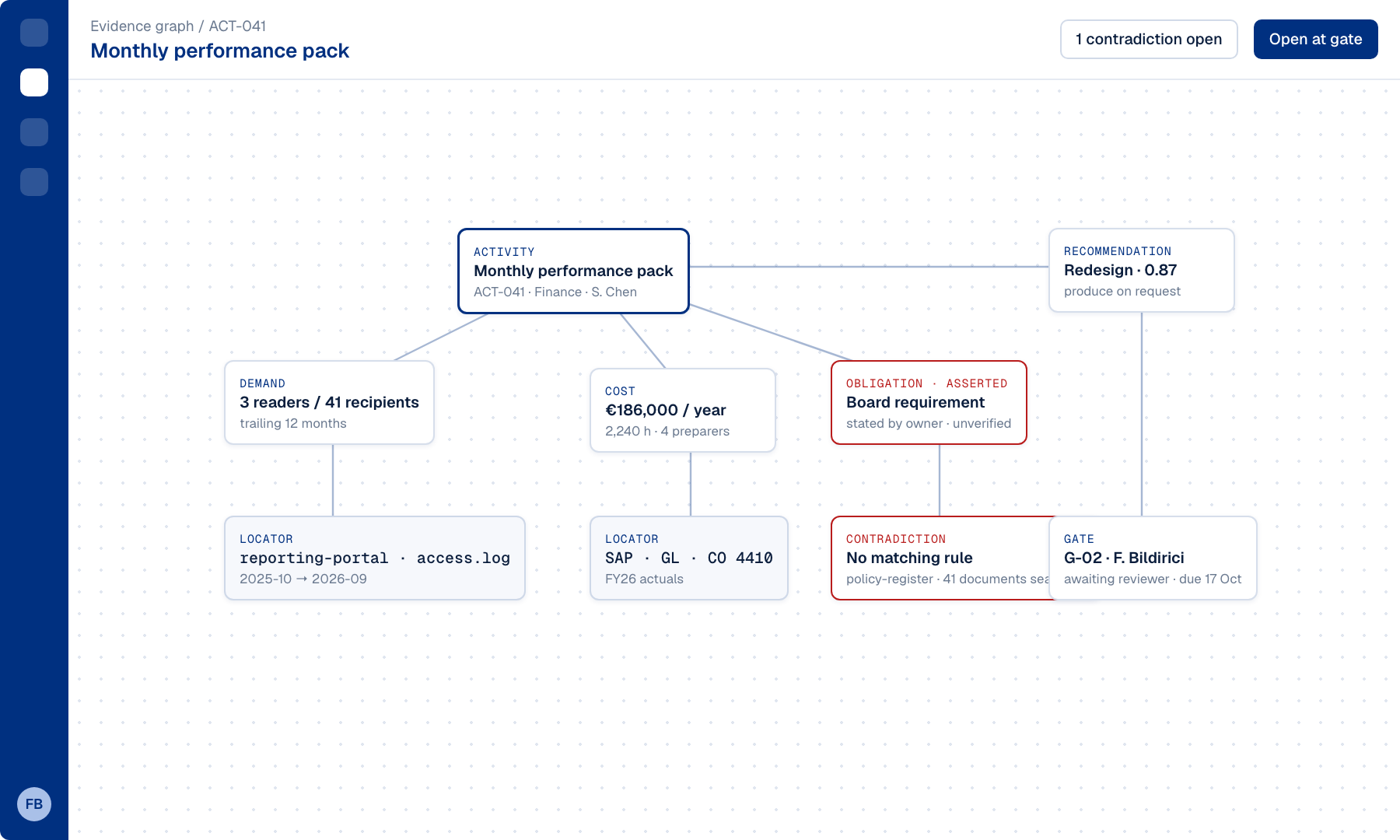
Activities, obligations, evidence, gates and decisions are typed objects with named relations. A figure is traceable to the system, query and period that produced it, and a contradiction stays visible instead of being averaged into a score.
Each agent carries a may and a may-not list; anything unlisted is denied. Consequential recommendations stop at a named reviewer, screened for conflict, who can move the decision in six directions, not just approve or reject.
Read-only connections, metadata only, aggregated above the individual. Cloud, private cloud, on-premise or isolated: the review runs where your data is allowed to be, including environments with no outbound access.
The same four steps run on every function. Each one narrows what the next is allowed to do, and nothing crosses a boundary implicitly.
Pick one function and lock its baseline: annual operating cost, capacity, activity list, service levels and the systems in scope. Approved sources are connected read-only, metadata only. Nothing is measured against a moving target.


 Microsoft 365
Every recurring activity gets a cost, a capacity draw, a demand source and a stated obligation, from event metadata rather than a workshop. Where the evidence is thin the agent says so.
Agents test the reason behind each activity. Where owners disagree the contradiction stays visible rather than being averaged away, and anything the evidence cannot settle stops at a named reviewer.
Remove, redesign, automate or keep, each with an owner, a reversibility class, the evidence it rested on and a date it will be looked at again. The workspace stays live after week eight.
These are starting scopes. Every one is bounded to how your function actually runs.
Establish which parts of the close are still required, what each costs a year, and which rule requires them. Never infer an obligation from precedent.
Start a Clean Sheet Review →
Trace every step in the chain, count what each one has actually rejected, and find the value at which it stops paying for itself.
Start a Clean Sheet Review →
Compare the documented route with the one tickets actually take, count the handoffs the gap produces, and make the real path the standard one.
Start a Clean Sheet Review →
Test whether an interval is set by risk or by habit: what it has found, what it costs, and whether condition data already answers the question.
Start a Clean Sheet Review →
Find who actually reads each recurring report, what producing it costs, and whether the rule that requires it can be located at all.
Start a Clean Sheet Review →
Compare the last six review cycles, count what changed, and decide whether a quarterly cadence is still a control or only still a calendar entry.
Start a Clean Sheet Review →
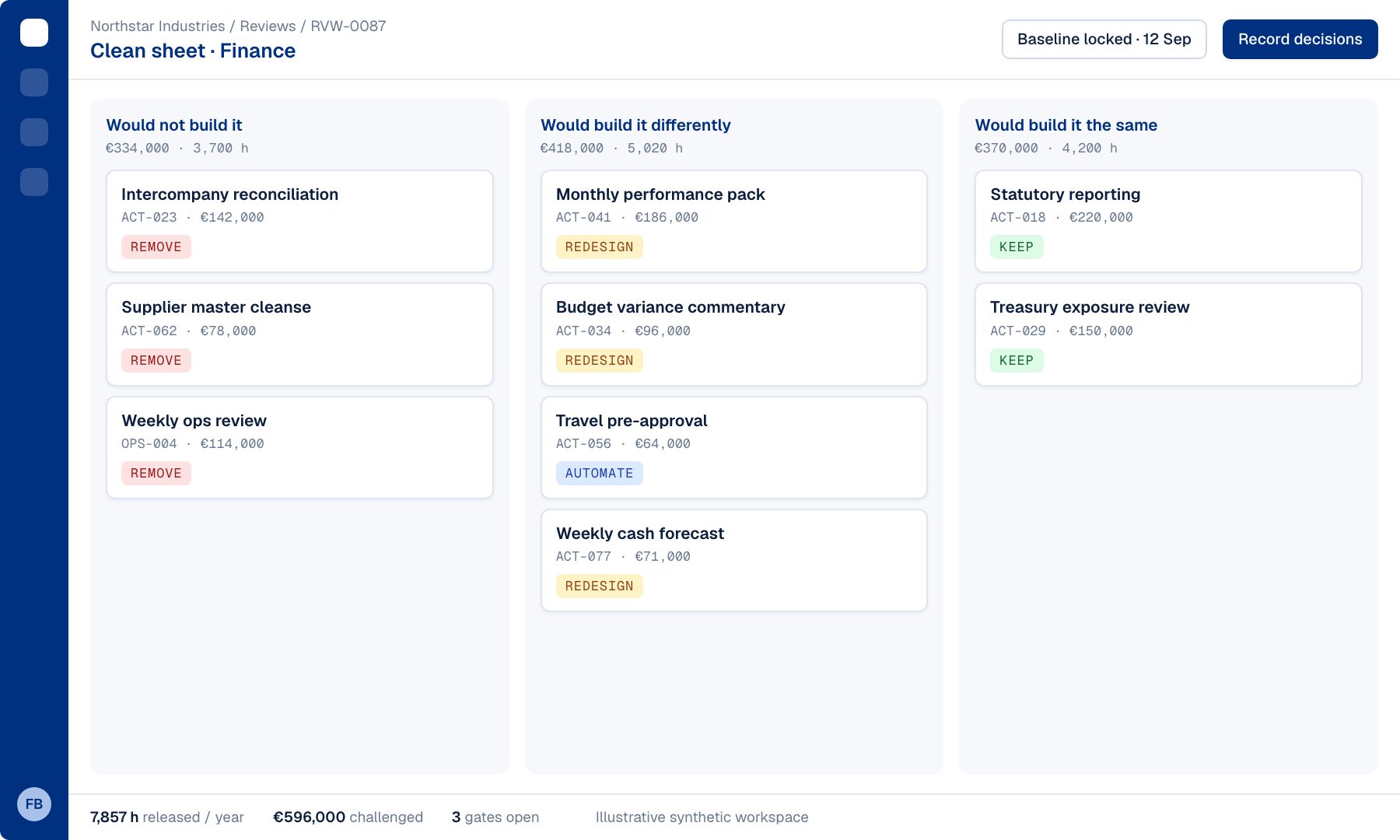
The clean sheet is the signature surface. Each activity goes into one of three columns and the cost and capacity delta moves with it. Not an optimisation of today’s process. The question is whether it would exist if you designed the function again.
A recommendation opens into a typed graph: the claims behind it, the system, query and period each came from, and the contradiction that stays visible instead of being folded away. This is the ontology: activities, obligations, evidence, gates and decisions as first-class objects with named relations.
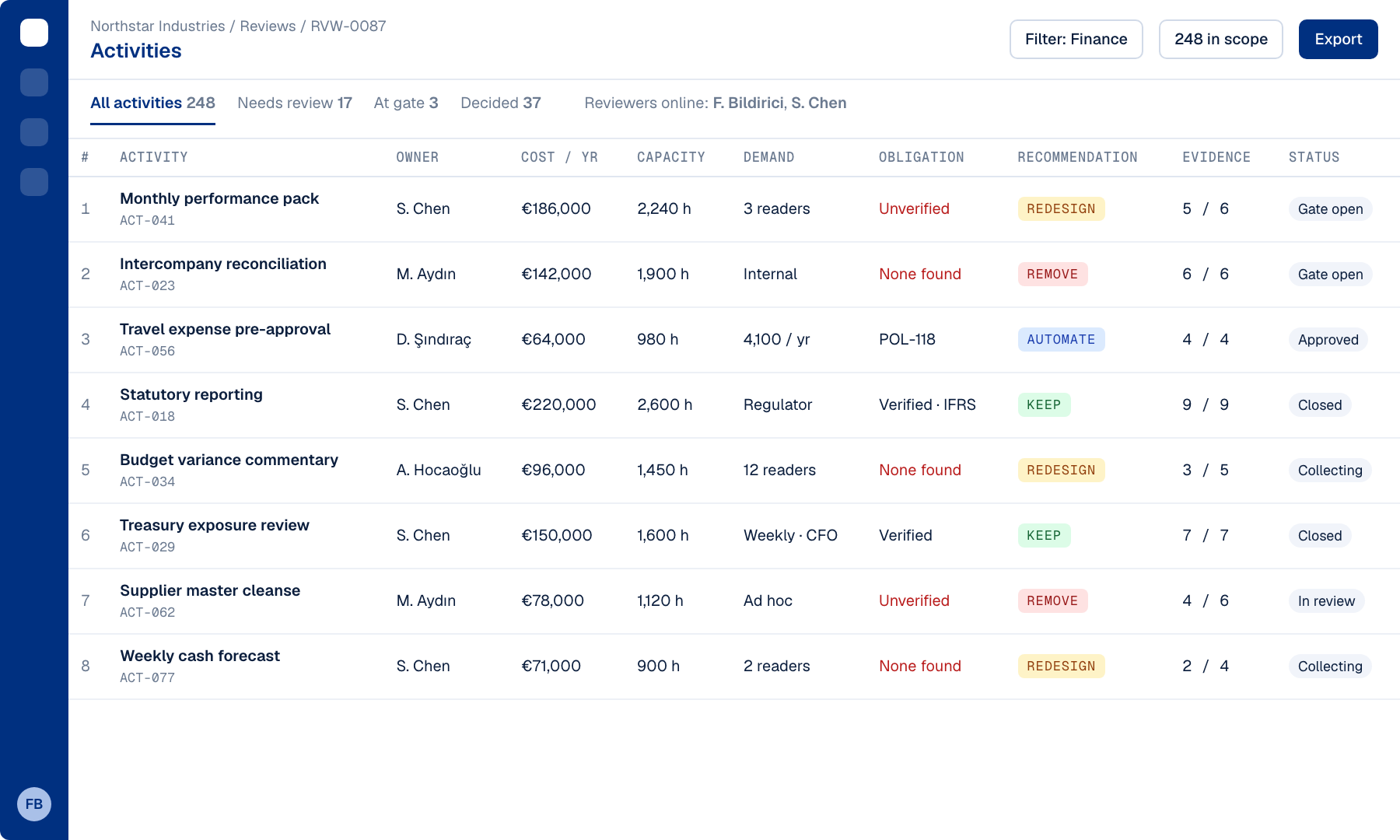
Function owners, named expert reviewers and the agents work one activity inventory. A reviewer can approve, challenge an assumption, request evidence, request an experiment, redirect or escalate, and everyone sees the same state, with the trail attached.
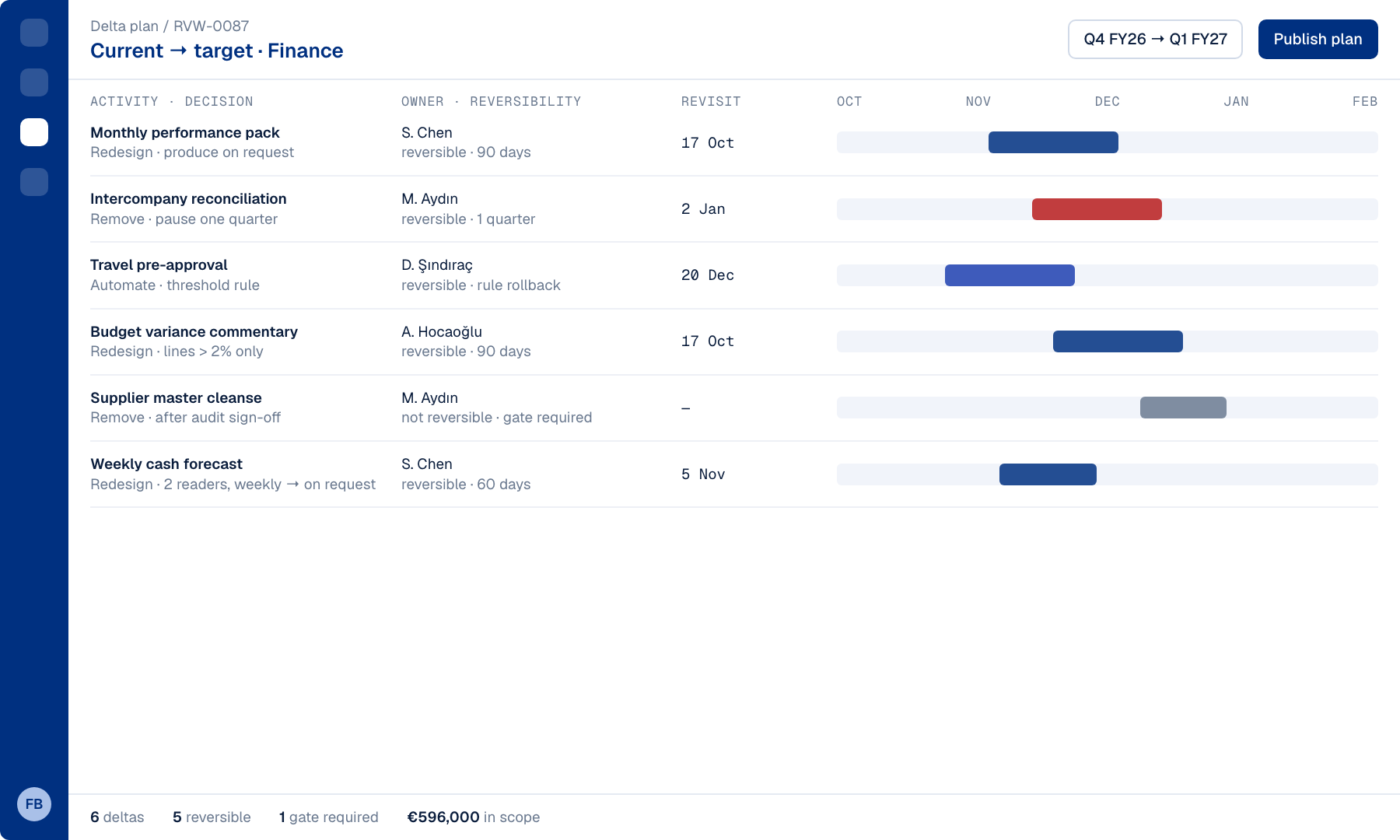
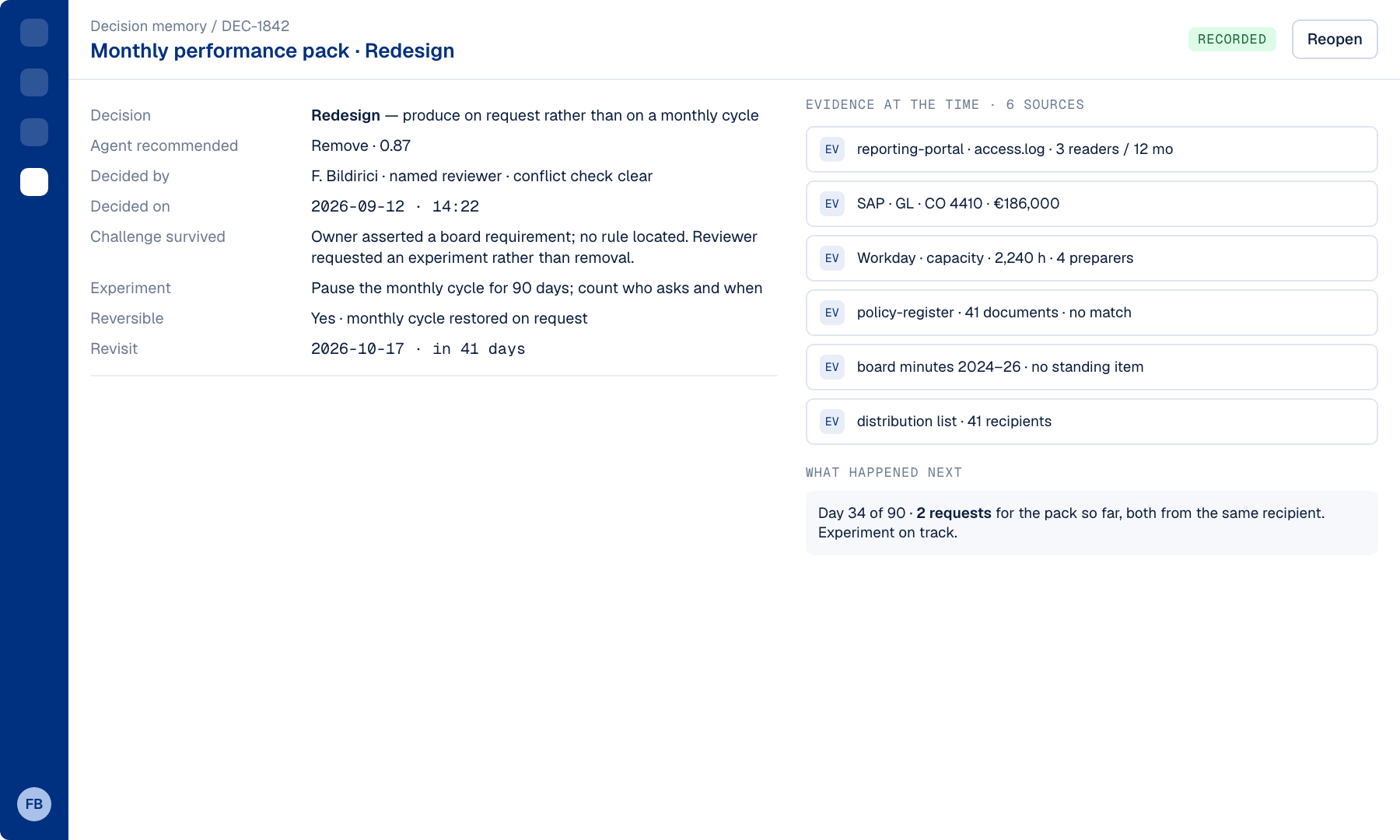
Every decision becomes a delta with an owner, a reversibility class, the experiment that tests it and the date it is looked at again. The plan is the set of deltas the evidence supports, not a roadmap written before the evidence existed.
Producing a recommendation is becoming a commodity. Holding why an organisation decided something, on what evidence, under which conditions and when it will look again is not. Decision memory is where reviews compound instead of restarting.
SAP, Oracle, Workday, ServiceNow, Jira, Microsoft 365, Slack, Salesforce and the internal systems around them. Nothing is replaced, and nothing is written to.

 Microsoft 365
 Slack
Slack Salesforce
Compatible source categories and deployment targets. Connector coverage is in design-partner validation; no live production integration is claimed.
ZeroBase sits between the systems you already trust. Sources change, thresholds move, reviewers rotate. The workspace keeps running and the memory keeps compounding.
Start a Clean Sheet Review →Keep the ERP, the ITSM, the document tools and the approval process your team already uses. ZeroBase reads them; it does not replace them.
Decisions live in a workspace with their evidence and history, not in one analyst’s spreadsheet or a consultant’s deck.
When a source changes or a threshold needs to move, the review keeps running and the change is recorded with the person who made it.
No consequential change goes live without a named reviewer, and anything not reversible waits at the gate before it moves.
Models read, classify and draft. They never decide what your operation does.
| A generic AI agent | ZeroBase |
|---|---|
| Decides what to do at runtime and can invent a figure or a rule. | Reads approved sources within a declared scope. Anything unlisted is denied. |
| Averages a contradiction into a confidence score. | Keeps a contradiction visible until a named person resolves it. |
| Hides its reasoning inside the model. | Keeps every claim with the system, query and period it came from. |
| Asks you to trust that the right thing happened. | Leaves a decision record with its evidence, its owner and its review date. |
Eight weeks from baseline lock to recorded decisions. About 90 minutes a week from the function owner and sponsor.
 A Future Innovation Agents product