Recurring packs, the same report kept in four places, runbooks nobody opens. Read from access logs and fingerprints, never the content. The AI-native form: one canonical copy, produced on request.

Build the operation you would build today.
If you founded the company today, with AI, you would not build most of the documents, meetings and approval flows you inherited. ZeroBase reads the systems your teams already run on, lists every recurring one with what it costs and who still needs it, and a named person decides what to remove, redesign, automate or keep.
See how it works →






 Zendesk
 Microsoft 365
 Slack
Slack


 Power BI
 Salesforce
If you founded the company today, with AI, would you build this again? ZeroBase asks that of every recurring document, meeting and flow, and a named person decides. AI is why the answer to the question has changed. ZeroBase is how you ask it with the evidence attached.
Start a Clean Sheet Review →Three kinds of work nobody would build again.
Most corporate waste is not a broken process. It is a report three people read, a weekly meeting that decides nothing, and an approval step no rule requires. Each was a workaround for information being expensive to gather, to move or to check. ZeroBase reads the metadata each one leaves behind and asks the same four questions of all three.
Fourteen invited, eight in the room, two decisions a quarter. Read from calendar metadata: recurrence, acceptance, agenda, decisions. The AI-native form: a Monday brief from the systems, a call only when it flags red.
Three approvals for a fifty euro expense; a step that has never rejected anything. Read from workflow logs: steps, rules, cycle time, rejections. The AI-native form: the rule stays, an agent applies it, a person sees only exceptions.
The four questions
01Who still needs it?
Readers, attendees and requesters, counted from the logs rather than asked.
02What does it cost?
Hours and euros a year, against a baseline locked before anything moves.
03What rule requires it?
Located and attached, or only asserted; the difference stays visible.
04What would it be if built today?
The AI-native form: the outcome kept, the scaffolding around it gone.
What establishing one obligation usually takes.
ACT-041 is a single activity. Before there is a boundary, answering one question about it means seven systems, four people and a figure nobody can source.
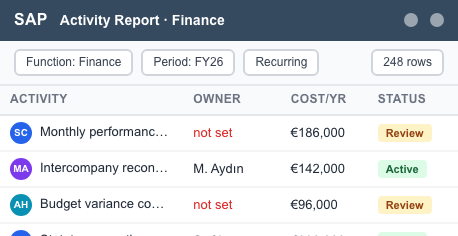
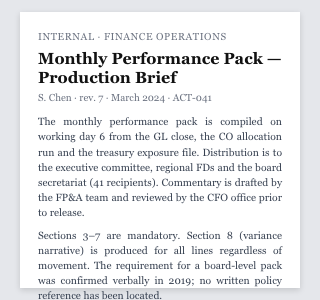
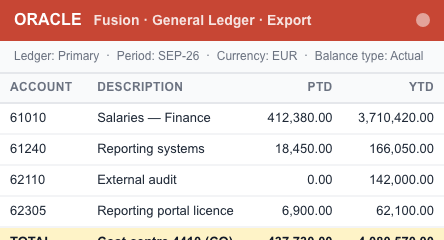 Two totals, neither reconcile
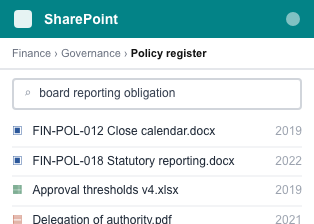 No matching rule
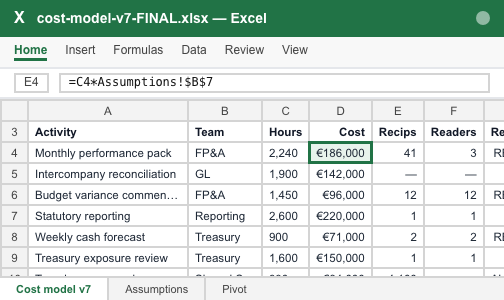
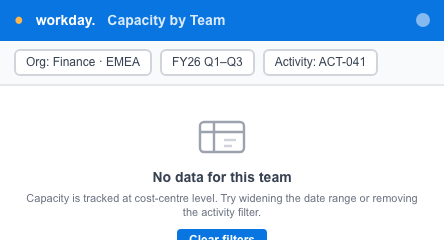
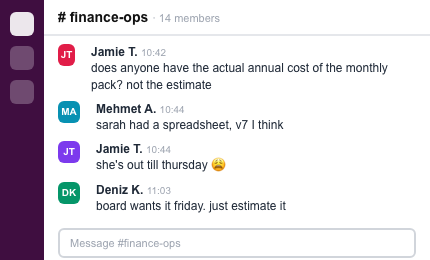
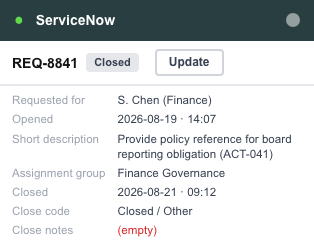
no owner listedfigures don't matchno matching ruleno capacity dataestimate, not evidenceclosed, no reason givenstill no answer
Takes one review on ZeroBase

Establish whether the monthly performance pack is a verified obligation. Return the demand, the annual cost, the capacity it consumes and the rule that requires it, every figure with its locator. Never infer an obligation from precedent.
 + 3 approved sources
EV
Monthly performance pack · ACT-041€186,000 a year · 2,240 h · 3 readers in 12 months
Evidenced
OB
Obligation check · policy registerowner states a board requirement · no matching rule located
Contested
G2
Reviewer gate · F. Bildiriciconflict check clear · redesign 0.87 · experiment requested
At gate
Illustrative synthetic workspace · not customer results
How a review runs, in four steps.
Approved sources are connected per review and scoped per function. Read-only, metadata only: event records, timestamps, volumes and routing, never document content.
For each activity the agent has to produce demand, a verified obligation, the annual cost and the capacity it draws, each figure carrying the system, query and period that produced it.
Demand3 readers / 41 recipientsVerified obligationnot locatedAnnual cost€186,000Capacity draw2,240 h
A named reviewer, screened for conflict, can approve, challenge an assumption, request evidence, request an experiment, redirect the question or escalate it. The threshold is workspace policy.
F. Bildiriciconflict check clearRecommendationredesign · 0.87Action takenrequest experiment
approvechallengerequest evidencerequest experimentredirectescalate
Remove, redesign, automate or keep, each with an owner, a reversibility class, the evidence it rested on and a date the organisation will look at it again.
Redesignagent said removeDecided byF. Bildirici · 12 SepEvidence at the time6 linked sourcesExperimentpause 90 daysRevisit17 Oct
Applied
Where organisations start with ZeroBase
 FinanceRecurring reporting, close and approval chains, where output accumulates fastest.
 OperationsReviews, inspection intervals and dispatch that were set once and never re-tested.
 ProcurementApprovals, supplier cycles and controls that rarely reject anything.
 Shared ServicesTicket routing, recurring requests and the exceptions that became the path.




Frequently asked questions
What is a clean sheet review?
A scoped review of one function that asks, for every recurring activity, whether it is still required at all, using the operating evidence the work already produces rather than the description of the process.
What evidence does ZeroBase read?
Event metadata from approved source systems: records, timestamps, volumes, routing and access counts. Never document content, and never a measurement attached to a named individual.
Can an agent change anything in our systems?
No. Connections are granted read-only. An agent may read an approved source, query within its scope, draft a recommendation and propose a reversible experiment. It cannot write to a source, approve its own recommendation or lower a human threshold.
Who makes the decision?
A named reviewer, screened for conflict. Consequential recommendations stop at a human gate whose threshold is workspace policy; the system cannot lower it.
What comes out of a review?
A decision per document, meeting or flow: remove, redesign, automate or keep, each with an owner, a reversibility class, the evidence it rested on and a review date. Before the decision, a clean sheet deck: twelve slides written from the established figures, frozen at the gate as part of the record.
Which work does ZeroBase look at?
Three classes of recurring work: documents, meetings and flows, plus any other recurring activity a function runs. Each class has its own metadata, its own waste signals and its own AI-native alternative, and all three go through the same four facts and the same gate.
Where do most reviews start?
Finance or Shared Services, where recurring output is dense and event data is already available. Procurement and Operations follow the same method against a different evidence set.
What does “AI-native” mean here?
Not adding AI to the work you already have. An AI-native operation is one you would design today: the reports, documents, approvals and flows that only exist because of how things used to be done are gone, and what remains runs with bounded agents and named people. ZeroBase is the first step: it finds that work and takes it out with the evidence attached.
Is ZeroBase in production?
ZeroBase is in design-partner validation. Nothing on this site is a certification claim, connector coverage is still being validated, and no production deployment or customer result is asserted.
Build from evidence. Decide with authority.
Start with one function. Leave with a living decision model.